Why Do We Use These Instruments In Cult Music?
The history of mankind reveals a multitude of instruments throughout the ages, each one adapted primarily to the specific region in which it appeared. But the question on the minds of many music lovers is: how have certain instruments come to be the defining characteristics of a particular musical genre?
A brief history
To find the answer to this question, we need to take a trip back in time. Many instruments originally used in worship music were gradually replaced or developed. Although it is recognized as a timeless universal language, classical music was not born in Europe and spread throughout the world until the 19th century, so many of the instruments that appeared or developed originated on the old continent.
If we look even further back to the Middle Ages, we can see that instruments were almost non-existent in cultured music, which was due to the religious conservatism of Christianity at the time, which offered the only form of this musical genre. Instruments were, however, used in secular music, which was too little thought of from a scientific point of view, but a real impetus for the emergence of genres that included musical instruments after the medieval period.
The first instrument allowed to be integrated into religious works was the organ, which evolved from the ancient Greek instrument Hydraulius. This first step encouraged, at the end of the Renaissance, when many learned genres were developing outside the church, the addition of other instruments to worship music. From here to the emergence of the first vocal-instrumental genres through the addition of already existing acapella genres was a short distance.
The rise of stringed and bowed instruments
The Baroque era begins with a true musical revolution. Composers became extremely attracted to instrumental music, and some even advocated strictly instrumental genres that emphasized the sonority and technical possibilities of different instruments. Corelli, Vivaldi, D. Scarlati, J.S. Bach and many other composers of the time begin to develop the technique of different instruments and outline various instrumental structures for their works.
In this period, it all starts with Monteverdi, the composer who first used multiple instruments for secular and religious music. String and bowed instruments, which were very popular among court musicians at the time, began to be used. However, in those early days of instrumental music there were also some instruments that are no longer used today, such as the viola da gamba or viola da bracia, the ancestors of the violin and the cello.
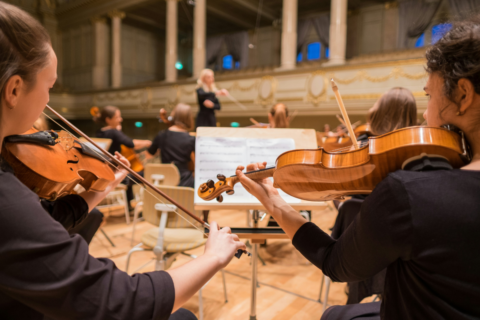
Few people know that the first of the stringed and bowed instruments to appear is the viola and not the violin. The famous Amati family of viol makers in the Italian city of Cremona gave birth to the first stringed and bowed instrument, which is still used today in symphony orchestras. Later, the other instruments in this family, developed by luthiers such as Stradivarius, appeared and quickly became extremely popular.
As they were new instruments at the time, it would take them a long way to perfect their playing technique. Corelli was the first composer to begin to develop violin technique, his work was complemented by Vivaldi, who brought the most complex playing techniques to the instrument in the pre-classical period.
The emergence of wind instruments
Let’s take a look at the wind instruments of the period, because here things are a little different. Unlike stringed and bowed instruments, most wind instruments had been present in musical life for hundreds or even thousands of years. The flute, the trumpet or the horn are some of the instruments that have been used in human history since ancient times, with different uses. For example, the trumpet was used in solemn ceremonies, the horn was used for various civil or military signals, while the flute was also played as a spiritual instrument in ancient times, being used in religious ceremonies.
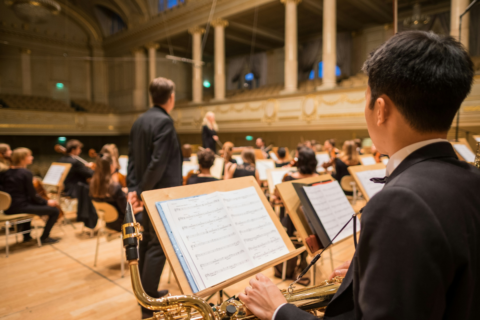
Let’s not forget percussion instruments, which, like wind instruments, have a rich history, being used in ceremonies or for various signals.
Yet another innovation of this period for instrumental music is the harpsichord. The extremely popular instrument used in pre-classicism, which disappeared with the advent and popularization of the piano, is itself still a stringed instrument, even if the strings are plucked.
This is how the first instrumental formulas take shape, with composers using this set of instruments to create new sounds. As the years went by, the evolution of the industry and the ingenuity of musicians led to certain changes in the instruments.
A constant process of evolution
After 1750, with the onset of classicism, we can see the emergence of the piano, an instrument too complex to be made with the technology of previous centuries, and the evolution of some instruments. In order to improve the technique of the right hand, the violin’s bow changed from the previous period, and stringed and bowed instruments, as well as woodwind instruments, began to be given more metal elements. New instruments such as the clarinet, an instrument much appreciated by Mozart, also appear.
The range of instruments used in orchestral and, by extension, classical music continues to expand today, but perhaps the peak of innovation and refinement of some instruments was during the Romantic period. Here, we see the most innovations in wind instruments, especially in brass instruments, which become chromatic.
- Evolution of brass instruments
To briefly explain this change, we need to know that before the 19th century brass wind instruments were limited in terms of playing the 12 chromatic sounds. For example, for a French horn to be able to play all 12 chromatic sounds required changes of “zugs”, which are elements that are part of this instrument of various sizes. One can only imagine how unpleasant it was for an instrumentalist to have to change, dismantle and replace various parts of the instrument during a concert. This was solved with the fan pistons that were added to most brass wind instruments, with the exception of the trombone of course.
- Evolution of woodwind instruments
Wooden wind instruments also receive the Boehm system, a finger system designed to seal the holes in these instruments. Because the flute was quite sensitive when it received this system and there was a risk of cracks developing over time, it was made of nickel and silver, materials that offered roughly the same acoustic characteristics as wood.
New percussion and wind instruments also appeared during this period, but of course not all of them found a place in the symphony orchestra, which remained largely faithful to the formula established in classicism.
After this brief glimpse into the evolution of instruments, the question remains:
Why these instruments?
First of all, classical music is based on balance, both in terms of its organization and its sound. So all the instruments in today’s formulation were created to satisfy this need for balance. If we take a brief look at the registers, we realize that for each category of instrument, whether we are talking about stringed and bowed or woodwind or brass, there are always four categories.
This way, a harmonic and timbral balance is maintained, while at the same time benefiting from diversity and specific timbral features, which are also the reasons why these instruments are used in today’s cult music.
_____
Akordaj is a platform created in the framework of the Spotlight on Music project, through the Erasmus+ program, funded by the European Union. The views and opinions expressed, however, are those of the author(s) alone and do not necessarily reflect the views and opinions of the European Union or the ANPCDEFP. Neither the European Union nor the ANPCDEFP can be held responsible for them.